





Employing People with Criminal Convictions in Construction

This report looks into the barriers and opportunities to recruit people with a criminal conviction into the sector.
Negative stigma and a lack of proper training opportunities are blocking many people with criminal records from earning a second chance at life within the construction industry, a Chartered Institute of Building (CIOB) report has revealed.
The report, Building Opportunity: Employing People with Criminal Convictions in Construction, shows individuals with a criminal record often face significant barriers to gaining employment within the industry including perceived risk to the business by employers and fears about business reputation. However, the report also shows that many construction businesses are taking proactive steps to make recruitment more accessible for people with criminal convictions.
It urges the Government to break down barriers and provide more accessible training opportunities to improve individual’s employability and ease the skills shortage in the construction industry.
Statistics show nearly 70 per cent of people leaving prison* are still without work six months after their release. CIOB says breaking down barriers could lower unemployment amongst people with criminal convictions and increase construction companies' social value impact.
A copy of the full report can be accessed via this link Employing People with Criminal Convictions in Construction report
Please note following a request from the New Futures Network (NFN), this statistic has been changed from nearly 75 per cent to nearly 70 per cent.
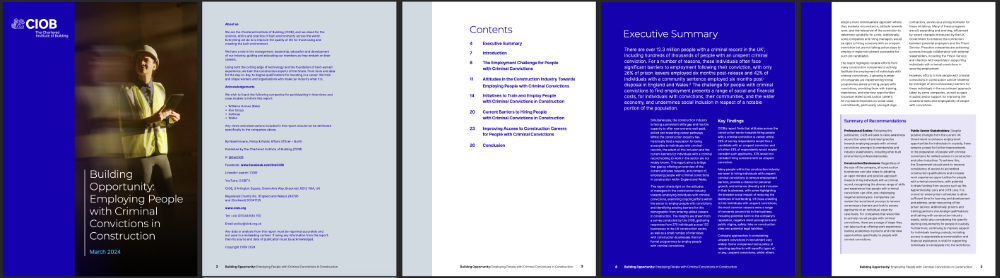
This article appears on the CION news and blog site as "Employing People with Criminal Convictions in Construction" dated March 12, 2024 and was written by Niamh Evans
[edit] Related articles on Designing Buildings
- Apprenticeships for prisoners.
- Building back better with apprenticeships.
- CIOB aims to help ex-offenders build a career in construction.
- Construction apprenticeships.
- Ex-offender Community.
- Industry work placement.
- Projects deliver meaningful change at young offenders institution.
- Non-residential institution.
- Residential institution.
- Secure residential institution.
- Tackling the construction skills shortage.
Featured articles
Check out some of the best features and news from Designing Buildings as well as key stories from around the web.

The real barrier to getting more value from digital technology.

Your guide to The Construction Reset at UKCW Birmingham.

Accommodating the Victorian and Edwardian working woman. Book review.
Rethinking passive fire protection in design

PFP demands the same level of design rigour as structure or services.

38% of Gen Zs feel safe when a fire door is wedged open.
Stunning images from around the world

Shortlist for CIOB’s Art of Building photography competition.

Guidance for conversion of traditional pre-1919 stone buildings.
Industrial heritage in the Ruhr

A marked difference to the fate of industrial landscapes in the UK.

Communities will be able to build their own clean energy.
Why diversity and inclusion matters for SMEs

CIOB’s D&I Charter shows how practical changes can support long-term growth.
Cut electricity bills to power growth

Coalition sends joint letter to the Chancellor.

Gasholders: a history in pictures. Book review.